A couple days ago, I got my new book in the mail. It is a children's book called Olga the Brolga. My favorite crane species. Olga wants to dance, but no one will dance with her. The illustrations are awesome and in the end, Olga gets her friends to dance. Super Cute!
Showing posts with label book review. Show all posts
Thursday, January 24, 2013
Olga
A couple days ago, I got my new book in the mail. It is a children's book called Olga the Brolga. My favorite crane species. Olga wants to dance, but no one will dance with her. The illustrations are awesome and in the end, Olga gets her friends to dance. Super Cute!
Saturday, May 21, 2011
Out of Eden
Since the weather isn’t great, I am having a lazy day. This morning I made myself a mug of coffee and then curled up in bed with a book and listened to the sounds of rain. Out of Eden by Alan Burdick looks into invasive species. From the brown tree snake to the zebra mussel, humans are responsible for transporting organisms faster and farther than they have been able to go in the past. Can we predict what impacts these species will have?
| Front and Back cover of the book! |
The brown tree snake is blamed for the extinction of several birds in Guam. Today the focus is on preventing its spread to another chain of islands – Hawaii. It will most likely get there someday, either in a crate on a shipping vessel or stowed away on airplane. The probability is in the snakes favor. The million dollar question is; what will happen when it does? There have been several well studied systems where species have been introduced (intentionally and unintentionally) and we still are awful at figuring out how the ecosystem will change.
The first third of the book gave me the hebe jeebies because it was all about snakes. Big brown tree snakes. These snakes are nocturnal (so you rarely see them) and have been caught in cribs trying to eat infants hands. EWWW! Luckily, the book moved to other animals and the third of the book really interested me because the author followed aquatic biologists looking into the transport of little aquatic critters. The zebra mussel is a famous example in the Great Lakes of an introduced species. Across the worlds bays though there are hundreds.
Towards the end of the book, the author raises an interesting question. Does nature need to be pristine for humans to enjoy it? Do we care if the wild around us ends up being identical world wide? While I am not too big of a philosophical person, it certainly is interesting. Species are constantly on the move. Does it really matter if we have sped the process up? I think so. If I ever make it to Madagascar or go back to Australia, I would certainly be disappointed if I saw only the same animals that we have in the mid-west United States...
Wednesday, May 4, 2011
Silent Spring
This book came out in 1962 and helped to start the environmental movement. The sad thing is that not a tremendous amount has changed in the nearly 40 years since its publication. We still douse our fields and homes in chemicals. Yes, we have many regulations today but it still makes me wonder. While what we use today may appear safe at first glance, what happens when it breaks down? When will we see the bigger picture? Nature may be providing us with an advance warning but will we be observant enough to notice?
Saturday, March 19, 2011
A Spring Without Bees
This book is pretty well summed up by its title. Its a book on the importance of bees and the recent development of bee colonies collapsing. I found several things interesting in this book. The bee species that we depend on to pollinate much of our agriculture in the United States had its genome mapped. Turns out it actually has a poor immune system. Not good in a society that wants to spray everything! Chances are the pesticides that we are putting on our fields and lawns are actually killing the very creatures we depend on to pollinate them. What makes the situation more appalling is the loopholes that allow the manufactures to get away with little to no testing of some of these pesticides. One would think that if it is being sprayed on a food crop there would be stringent testing but apparently that is not always the case.
I also found interesting the comparison of pesticide use on agriculture fields to that on golf course and neighborhood lawns. Turns out that Americans have the perception that a green lawn is the only good lawn. This means that in many areas neighborhood lawns and golf course use more water and pesticides than any food crop. Something to think about. I don't have a lawn and don't golf but is that perfectly manicured lawn really worth it? I would rather have a bunch of native plants and wildlife any day of the week.
As I got further into the book, the author did get up on his soap box a bit. I actually got a bit annoyed in a couple spots - I get it. "We should try and switch to organic farming so the bees do not ingest the pesticides. Bees are critical to our environment". Despite that, I found that this book presented some interesting facts to think about. And I think we all need to thank our little friends for how much they contribute to our daily lives.
Monday, March 7, 2011
Soaring with Fidel
I have been a major reading kick lately. In part because I've had a lot on my mind the past couple weeks. It also helps that I just got a bunch of books from Barnes and Noble for cheap! I had a bunch of gift cards and coupons so I got 6 books for a total $5 from my pocket. One of the ones I bought was called Soaring with Fidel. This book combines my love of travel and nature as the author goes on a journey from Cape May to Cuba and beyond following Osprey.
The book focused more on the traveling with osprey as the background. In that regard it was slightly disappointing (although I did still learn a few tidbits). What made me jealous was how lucky the author was. He was able to take decent chunks of time away from work and had a friend bankroll the trips. Many of the people he encountered along the were big birders and have had a large influence on osprey research. That said, I would love to be able to take a trip like his (yeah, I have the travel itch again!). But hey, if I can't travel I guess reading about someones trip will have to do for the time being.
Saturday, February 26, 2011
Kabul Beauty School
I took a small diversion from my regular non-fiction books and read this true story about a woman who helped set up a beauty school in Afghanistan. After leaving behind a bad situation in the states, she traveled as a volunteer for an NGO. The book follows her struggles figuring out how to help women earn a living after going through remarkable circumstances. I don't know that I would be brave enough to go to a country where there is a language barrier and threats to your well being on a daily basis. Props to her. In the past couple years she has had to leave everything she loved due to the threat level but she is hoping to go back. As the book drew to a close, all I could think was Deb Rodriguez is one gutsy woman.
Wednesday, February 9, 2011
Four Fish
I came across this book on a trip to Barnes and Noble - thought it was looked interesting but didn't buy it. Then, for my birthday this past year, my parents surprised me with it! I hadn't even put this title on my wish list. Apparently there had been some hype behind this book and it was making the non-fiction "books you should read" lists of publications like Newsweek and they thought I would like it.It was certainly an interesting read. As the title implies this book looks at the life history of 4 fish that often end up on someones dinner plate - Salmon, Sea Bass, Cod and Tuna. I really enjoyed his take on aquaculture. Yes, there are many species currently being farmed. The problem is the manner in which it is being done. Traditional aquaculture practices rely on a polyculture. Take the coy ponds of China - in these ponds the system involves algae, fish and ducks (at a minimum). The idea is that all elements in the pond feed on each other in a loop of sorts.
Today, many farms over look this and have a monoculture. This is where the problems begin. The waste builds up and creates anoxic conditions as well as the potential for disease. These farms also are usually dealing with genetically altered fish which can cause lots of problems when the fish escape and mix with the already stressed wild populations. A third problem is that many of the farmed fish today are carnivorous and require an excessive food input per pound of fish - in some cases 20 pounds of fish lower on the food chain to create 1 pound of tuna.
The good news amongst all this is there are alternatives for those of you eating fish. A couple new aquaculture species show that fish can be produced as a polyculture with minimal environmental impact and the product can go to market at a relatively low cost. The problem is people seem attached to the species currently on their plate. If, however, some of the pressure isn't reduced on our current populations those familiar species may no longer be available to the common person. The other good news is that people are starting to realize just how important marine sanctuaries are to fish populations - if you give the population a chance to rebound before its too late it often happens quickly. A win for the fish and a win for fisherman.
Another good read. It was well written - mixing the authors personal experiences with the science made for a page turner. In fact, a couple of my co-workers have already expressed interest in borrow it!
Monday, February 7, 2011
Wesley
I finished reading another book last month. This one is called Wesley the Owl by Stacey O'Brien. Its the story of a young woman who raises an owl in her home. I had heard this book was well worth the read from several folks so I gave it go.
This lady intentionally imprinted a barn owl on herself. As the owlet grew to be an adult, it showed that he considered her to be his mate - even tried feeding her mice on a regular basis. (I can't even imagine what I would do if one of the kestrels put a dead mouse in my mouth...GROSS!). For nearly 2 decades she cared for this owl in her home and recorded its behaviors. What she recorded was shared with an owl research laboratory - much of which were behaviors never before observed.
Of course, like all animal books of this nature, this one has a sad ending. For me, the most interesting aspect of this book was how much things have changed over the years in terms of animal care, understanding and regulations. Today, regulations prohibit anyone from doing something similar and with good reason.While I do usually think that owls are overrated (I am a falcon girl you could say) this book was a nice quick read that kept me interested. I even passed this book on already to one of the interns.
This lady intentionally imprinted a barn owl on herself. As the owlet grew to be an adult, it showed that he considered her to be his mate - even tried feeding her mice on a regular basis. (I can't even imagine what I would do if one of the kestrels put a dead mouse in my mouth...GROSS!). For nearly 2 decades she cared for this owl in her home and recorded its behaviors. What she recorded was shared with an owl research laboratory - much of which were behaviors never before observed.
Of course, like all animal books of this nature, this one has a sad ending. For me, the most interesting aspect of this book was how much things have changed over the years in terms of animal care, understanding and regulations. Today, regulations prohibit anyone from doing something similar and with good reason.While I do usually think that owls are overrated (I am a falcon girl you could say) this book was a nice quick read that kept me interested. I even passed this book on already to one of the interns.
Wednesday, November 24, 2010
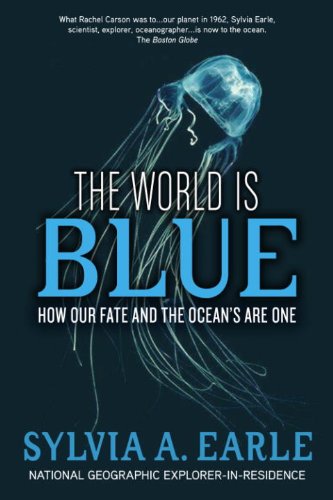
The World Is Blue
I had high hopes for this book since I have such a love for the water and the creatures residing in it. Sylvia Earle is a very accomplished scientist - she has served on numerous committees and has even been the chief scientist for NOAA. That being said, I was a little let down by this book. Earle shares her experiences with readers as she talks about the changes in the ocean during her lifetime. Her stories make me want to explore the oceans myself. But the book as whole, offered little new information to me. Perhaps its because I have read a lot on the oceans perils recently. Don't get me wrong. Its a good book, if you want an introduction to marine conservation.
I walk away from this book still frustrated by the global policies pertaining to the ocean. The oceans account for 3/4 of the planets surface area and today less than 1% of the ocean is protected. Much of the blue world is still unexplored. This large body of water has long been viewed as being beyond human influence. Like it or not, our influence can now be seen everywhere. If we don't change the way we treat our resources, there will come a time soon that they are no longer available.
Okay, I will now get off my soap box. For now.
Wednesday, November 10, 2010
Migration
For my birthday, I received a bunch of books that have been on my “To Read” list for quite some time. One of the books was No Way Home: The Decline of the World’s Great Animal Migrations by David Wilcove. This book takes you through some of the world’s most amazing migrations of the sky, water and land. It starts with birds and monarchs. Next, the author follows the migrations of the large mammals in Africa and North American plains. Lastly (but perhaps the most interesting to me) was the migrations of whales, turtles and salmon.
The message of this book is about the disappearance of the worlds major migration events. While many of the animals are in no immediate threat of extinction, the scale of these events is changing. Rather than having heards that have millions of buffalo, we now have much smaller herds of a couple hundred or thousand. The reason for the change is simple; the success of a predator known as Homo sapiens. Humans have single handedly changed the landscape in more than one way. Each of these could have an impact on a population but as a whole the impacts are far reaching. We have hunted animals to the point of extintion (or close to it). We have broken up the forests so migrating animals no longer have resting spots. We have polluted our waters so much that fish and whales get tangled in fishline or mistake plastic bags for jellyfish. The list goes on.
Some people may say that we shouldn't be concerned. These animals have numbers that show they will be around for decades still. But these are the events that inspire us and take our breath away. That is worth a lot (in my opinion anyways). I hope to see at least one of these great migrations soon - perhaps one spring I will see the Sandhill Cranes at the Platte River in Nebraska. This is a nice quick and informative read. Whats really fun is that I already got to use some of the information in a class taught at Audubon!
Monday, October 11, 2010
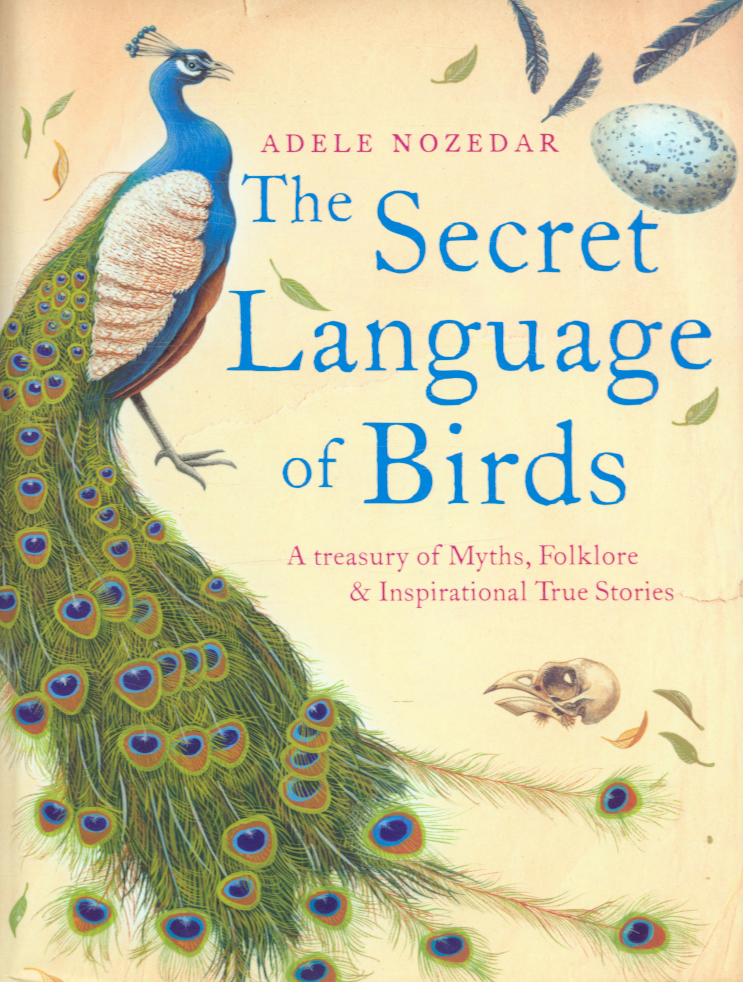
Secret Language of Birds
I bought this book a couple months ago now but I still think that it is worth sharing. Its called The Secret Language of Birds by Adele Nozedar. This book has more than 500 pages of myths and folklore about birds.
- Condors are unflappable people who are able to achieve a great deal without seeming to try. (Ask my sister about this one; she'll say its true)
- Condors do not suffer fools gladly, but rather than endure a difficult or boring person, they will simply walk away; this bird cannot bear to be bored in any way. (Yep, I've done that on more than one occasion)
- Condors need to have a great deal of freedom in any chosen profession; they work much better if just left to get on with the task at hand. (Again, this is true)
- Once the condor has decided that you are its friend, the friendship will last for life, and any small arguments or pettiness will be forgiven immediately. (I think this is accurate, I tend to let the little things go. But watch out if you get on my bad side!)
Saturday, September 25, 2010
Biography of a Germ
Awhile ago, I bought a bunch of clearance books online. One that I was really excited to read was Arno Karlen's Biography of a Germ. I am sad to say, that this book wasn't what I expected. Perhaps, I was thinking it would be mainly about the life of the bacteria that cause lyme disease and what it does to humans. It started out talking about the history of biography; something that is of very little interest to me. Next, was a biology lesson about shapes of bacteria before moving on to a bit about the germ and its many defenses that confuse our immune systems.
Even though I was disappointed in this book, I did learn a few things about this small germ. The bacteria is found world wide and lyme disease wasn't identified until in the United States until the mid-1970's. Ticks were not confirmed at the transmitter for another decade. The real kick in the teeth is that our current lifestyles is creating the ideal habitat for ticks and this bacteria. Even today, much is speculated about the bacteria and its life cycle but very little is confirmed.
Sunday, September 19, 2010
The World Without Us
I recently finished reading The World Without Us by Alan Weisman. It was interesting to contemplate what would happen if all humans suddenly disappeared. How long would our presence be on Earth? Some things, like New York City's subway system and paintings, would be destroyed in a few years without humans to maintain them. Other things, like the waste from our nuclear experiments, would likely be around as long as the planet. The radio waves we broadcast would be fragmented, but around indefinitely.
Little scary to think that long after we are gone we will still be impacting the planet. That is something that no other species can say. Nature however is resourceful. It wouldn't take long for animals to begin to rebound and domesticated animals to disappear. Perhaps, one of the greatest predators that humans have introduced is the humble house cat. Long after humans and domestic dogs are gone, feral cats will continue to wreck havoc on the bird population. The only we can say for certain is that after humans are extinct, life on this planet will go on. Probably in forms we have never dreamed of.
Sunday, May 16, 2010
Banana
I recently finished a book called: Banana - The fate of the fruit that changed the world written by Dan Koeppel. It may seem like a book about bananas may be a bit borning. Let me assure you that it wasn't. This book was actually a quick and fascinating read, especially considering that I have never eaten a banana.
- American's eat more bananas than oranges and apples combined.
- All bananas sold in the United States are clones of each other. This is proving to be problematic as a fungus is wipping out the banana we eat - i.e. if one banana gets sick, all bananas get sick. Some experts think that this species of banana may be extinct in as little as 2 decades.
- The species of banana that we eat is one of the poorest bananas nutritionally and taste wise (just ask anyone who as been to an area where the fruit can be grown and sold locally).
- The banana companies have had more influence on governments (both home and abroad) than I would even care to think. It just blows my mind that they have been responsible for the rise and fall of entire countries.
Tuesday, April 6, 2010
Grayson!
This is a true story about a 17 year old girl who went out for an open water workout off the coast of California. At the end of her work out, she had a baby grey whale following her so she couldn't get out of the water. The book recounts how she swam in the channel for several more hours to try and reunite the whale with its mother.
It was a quick read and a feel good story with a happy ending. This also makes me wish that I lived along a coast so I could see even a couple of the fun critters she talked about!
Monday, January 11, 2010
Where the Wild Things Were
For much of the past weekend, the intern house was without internet. This was fine by me because I spent a lot of time curled up in bed with a cup of coffee and a good book. I just finished one of the books I got for Christmas - Where the Wild Things Were by William Stolzenburg. This is a book about the disappearance of large predators around the world and the impacts of their absence. It looks at many of the major papers in Ecology and breaks them down into simple terms.

The book starts with Paine's essay about a predatory starfish and tide pools along the Western coast of North America. When all the starfish were removed from a tide pool for several months in a row, the diversity of life within that tide pool plummeted. From there, the book moved on to larger oceanic predators including the killer whale. The killer whale is made to eat large meat. If you compare the jaws of the orca to that of t-rex, they look almost identical. A single killer whale has to eat 5% of its body mass a day which can amount to 600 pounds! These whales are like the wolves of sea, hunting in pods and capable of taking down a blue whale.
The charismatic large predators like the wolf and African lion were also talked about. What struck me was the fact that in much of the world today, the megafauna are missing. In their absence, small and medium sized animals like the deer, domestic cat, raccoon, and coyote have taken over. Deer are now in such high densities that some forests have been browsed beyond recognition. Domestic cats alone kill over 1 billion small critters a year and are the prime suspect in the extinction of 33 species. As recent as the early 1900's these medium sized pests would have been kept in check by the large predators now missing. The return of wolves to Yellowstone has shown that when apex predators are present, the ecosystem is healthier and has higher diversity.
The books ends talking about the greatest predator ever to walk this planet - humans. For all our good intentions, we have developed technology that allows us to change our surroundings faster than any species that came before us. Its interesting to think that while trying to make the world safer for ourselves, we may be causing more problems. Overall, I enjoyed this book - it was easy to read, made me think and I learned a few fun facts along the way!

The book starts with Paine's essay about a predatory starfish and tide pools along the Western coast of North America. When all the starfish were removed from a tide pool for several months in a row, the diversity of life within that tide pool plummeted. From there, the book moved on to larger oceanic predators including the killer whale. The killer whale is made to eat large meat. If you compare the jaws of the orca to that of t-rex, they look almost identical. A single killer whale has to eat 5% of its body mass a day which can amount to 600 pounds! These whales are like the wolves of sea, hunting in pods and capable of taking down a blue whale.
The charismatic large predators like the wolf and African lion were also talked about. What struck me was the fact that in much of the world today, the megafauna are missing. In their absence, small and medium sized animals like the deer, domestic cat, raccoon, and coyote have taken over. Deer are now in such high densities that some forests have been browsed beyond recognition. Domestic cats alone kill over 1 billion small critters a year and are the prime suspect in the extinction of 33 species. As recent as the early 1900's these medium sized pests would have been kept in check by the large predators now missing. The return of wolves to Yellowstone has shown that when apex predators are present, the ecosystem is healthier and has higher diversity.
The books ends talking about the greatest predator ever to walk this planet - humans. For all our good intentions, we have developed technology that allows us to change our surroundings faster than any species that came before us. Its interesting to think that while trying to make the world safer for ourselves, we may be causing more problems. Overall, I enjoyed this book - it was easy to read, made me think and I learned a few fun facts along the way!
Thursday, December 17, 2009
A Sand County Almanac
For several years now, the Aldo Leopold book A Sand County Almanac has been on my list to read. While I have read some passages before, I have finally read the book in its entirety.As I read, it amazed me how far ahead of his time Leopold was. Written in 1949, many of the concepts brought up in the essays are still relevant today.
Perhaps my favorite essay is Prairie Birthday where Leopold talks about watching prairie plants bloom in a cemetery that he drives past daily. "Tell me of what plant-birthday a man takes notice and I shall tell you a good deal about his vocation, his hobbies, his hay-fever and his the general level of his ecological education." It really intrigued me because it talks about the desensitization of people. We can often overlook the beautiful things that are right in front of us simply because we are not paying attention.
If you are interested in nature and haven't read this book yet, I would highly recommend it.
Subscribe to:
Posts (Atom)